- Sceneform SDK for Android was open sourced and archived (github.com/google-ar/sceneform-android-sdk) with version 1.16.0.
- This site (developers.google.com/sceneform) serves as the documentation archive for the previous version, Sceneform SDK for Android 1.15.0.
- Do not use version 1.17.0 of the Sceneform Maven artifacts.
- The 1.17.1 Maven artifacts can be used. Other than the version, however, the 1.17.1 artifacts are identical to the 1.15.0 artifacts.
In Skype for Business, click the down arrow next to the gear icon, select File, and then Sign Out. Click Delete my sign-in info. If the issue persists, continue to remove the cache. Step 2: Remove Skype for Business cache. Exit Skype for Business. For example, click the down arrow next to the gear icon, select File, and then Exit. Once you run the prepare AD step you will create the Sfb related AD groups. Part 3 describes deploying Skype file store. In short, these groups need full permission. The File Hider is used to hide files in windows. It uses super hide method of windows and it can open the files which is hidden by virus programs. It uses super hide method of windows and it can open the files which is hidden by virus programs.
Learn how to import 3D models, convert them into Sceneform format, and previewthem in Android Studio.
Note: To import and work with 3D models in Sceneform, ensure you have installed the Google Sceneform Tools (Beta) plugin.Import a new 3D asset
Sceneform supports 3D assets in the following formats:
- OBJ
- glTF (animations not supported)
- FBX, with or without animations.
Follow these steps to import a new 3D asset:
Verify that your project's
appfolder contains asampledatafolder.To create the folder, right-click on the
appfolder in the Projectwindow, then select New > Sample Data Directory.The
sampledatafolder is part of your Android Studio project, but itscontents will not be included in your APK.Copy your 3D model source asset file (
*.obj,*.fbx, or*.gltf), andall of its dependencies (*.mtl,*.bin,*.png,*.jpg, etc.)into thesampledatafolder.Do not copy these source files into your project's
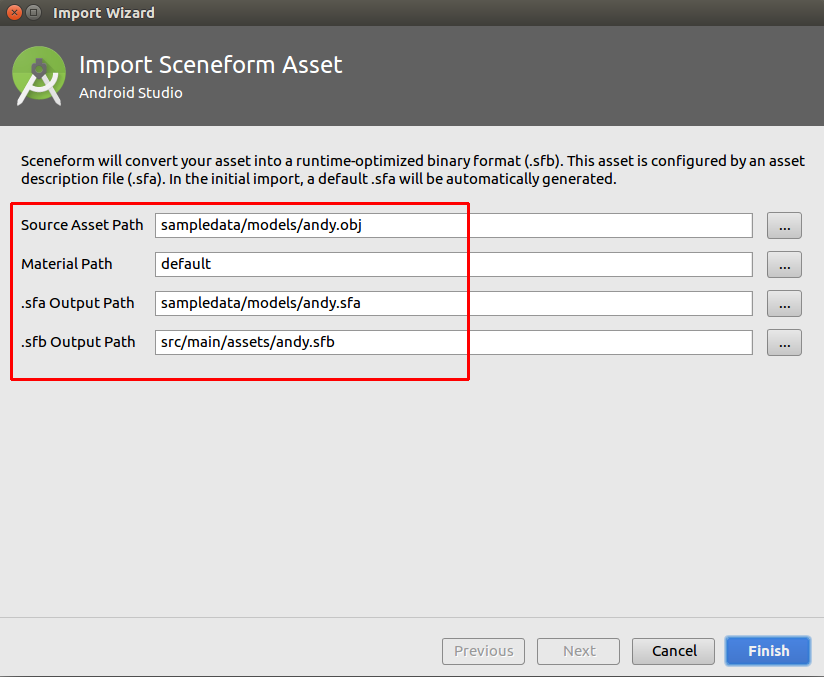
assetsorresfolder,as this will cause them to be included in your APK unnecessarily.Right click the 3D model source asset and select Import Sceneform Assetto begin the import process.
The values are used by the
sceneform.asset()entry in the app'sbuild.gradle, and determine where the*.sfaand*.sfbfiles will begenerated in your project.If you're importing a model for the first time, use the default values.
Field Description Source Asset Path Filename of the OBJ, FBX, or glTF 3D model asset to import. Material Path defaulttells Sceneform's to use the built-in default material or the path to a custom material*.matfile..sfa Output Path Use the default, or specify another path under the sampledatafolder.The .sfa file is generated if missing. It can be modified to control some aspects of the import process.
This ensures that
*.sfaisn't included in your APK unncessarily..sfb Output Path By default the src/main/assets/folder is used, which allows the use of arbitrary asset filenames.If the filename (without file extension) is a valid resource identifier (e.g.
R.raw.filename), then you can instead use thesrc/main/res/raw/folder if you prefer.See Android's App resources overview for more on using the
assets/andres/folders in your app.Animation Files If you are importing
*.fbxanimation files, click the plus sign (+) and add the rest of the files individually.Click Finish to begin the import process.
To import your asset, the plugin does the following:
Adds the Sceneform gradle plugin to your project's
build.gradleif itdoesn't already exist:Updates your app's
build.gradlefile to include anapply pluginline, and asceneform.asset()entry for the newly imported asset:These new entries in the app's
build.gradlecreate two gradle tasks:createAsset-<asset-name>creates a Sceneform asset definition(*.sfa) file if it does not yet exist.This task will not overwrite an existing
*.sfafile, which means anymodifications you make to the SFA file after import won't beoverwritten.The
*.sfafile is a text file that contains a complete, human-readabledescription of the asset's import settings. It references the models andtextures in your source asset, and also defines materials by providingmaterial parameters for Sceneform's physically based materials.compileAsset-<asset-name>compiles the*.sfafile into a Sceneformbinary asset (*.sfb) file.This
*.sfbfile gets built into your app's APK and is loaded atruntime to create the renderable.
For more information, see theSceneform Gradle Plugin reference.
Opens the
*.sfain a text window and the*.sfbin a Viewer window.
Update a previously imported 3D asset
When you update a previously imported OBJ, FBX, or glTF model source asset file(*.obj, *.fbx, or *.gltf), the corresponding sceneform.asset() entry inyour app'sbuild.gradle causes the plugin to automatically generate anupdated *.sfb file, based on the current *.sfa parameters.
To iterate on the parameters for an already imported asset:
- Modify the
*.sfatext file, using theSFA file format reference as a guide. - Save your changes. This causes the asset to be recompiled and updates the
*.sfbfile. - Preview the updated asset by double-clicking the
*.sfbfile to open theasset Viewer window.
If you are updating a previously imported asset that includes animation data,import each of the updated *.fbx files individually using the plus (+) signin the Animation Files section of the import dialog.
Gradle asset definitions
The import process adds any *.fbx animation files at the end of thebuild.gradle file.
Create the Renderable
Once the asset is compiled into *.sfb format, you can build aModelRenderableand attach it to a node in the scene as follows:
Sfb File Reader
Using custom materials
Sceneform'sdefault materialsmake it easy for developers to get great lookingresults. You can also usecustom materials to deeplycustomize the way your assets look.
Sfb File Extension
To assign a custom material to your asset:
Create a custom material definition (
*.mat) file, using the[Custom Material Reference](/sceneform/develop/custom-materialas a guide.Apply the custom material to the asset:
When importing a new asset:
- Specify the custom material
*.matfile during theimport process.
To update a previously imported asset:
If the
*.sfacontents have not been customized, delete the existing*.sfaand*.sfbfiles and thesceneform.asset()entry in theapp'sbuild.gradle, then reimport the asset.This ensures that the regenerated*.sfaattributes and materialparameters will match the ones supported by your custom material.To preserve any
*.sfacustomizations you've made, open the*.sfafile and change thesourceattribute to the path to your custom material*.matfile, thenmanually adjust the*.sfaattributes and material parameters to matchyour custom material.
- Specify the custom material